Some coaches believe you can’t effectively coach yourself, I respectfully disagree. It is undoubtedly different to other forms of coaching, but can still make a real difference.
Coaching is not therapy. It assumes you are resourceful and the answers are within you – subject to a safe space, your efficacy, an effective relationship with the coach, the chance to think afresh, the ability apply what you learn. If you are able to provide these things skill-fully for yourself, you could benefit from self-coaching.
Done well, self-coaching can…
- help you gather your thoughts ahead of important conversations
- help you make sense of something that’s bothering you
- help you structure and organise your thoughts
- help you figure out your priorities
Self-coaching isn’t a substitute for conversations with other people. Conversations with your manager, mentors, your work best friend, a professional coach, previous colleague, or family members can help, though not always!
Self-coaching is the practice of guiding your own thinking in a structured way – helping you make a shift with an issue, an opportunity, or a course of action.
Like coaching, self coaching is a practice – worthy of care, attention, skills development.
A few watch outs / limitations
Naturally, you miss out on what an unbiased coach can bring – including their perspective, support, feedback, tools, challenge.
It can be hard to think differently on your own. There can be a risk of going round and round in circles, reinforcing your own thinking.
Coaching involves holding a safe space, so self-coaching relies on your own resilience and ability to do so.
Sometimes your inner voice(s) can be very judgemental – more so you would be with other people. You need to be able to tame your inner critic.

Self-coaching requires, and cultivates, high levels of self-regulation and self-motivation which are two integral parts of self-leadership
(Fukuda, Sakata, & Pope, 2019)
Developing your self-coaching practice
In developing your self-coaching practice, there are three inter-related aspects to work on – your mindset, your skillset and your toolset.
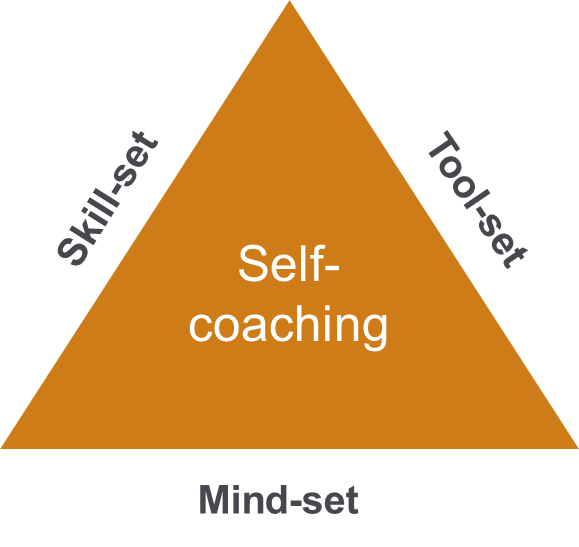
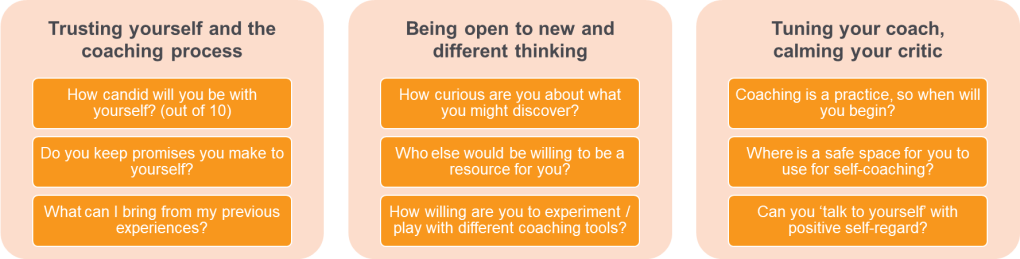
The key place to start is your mindset. How ready is your mindset? Take a few moments to consider these reflection questions.
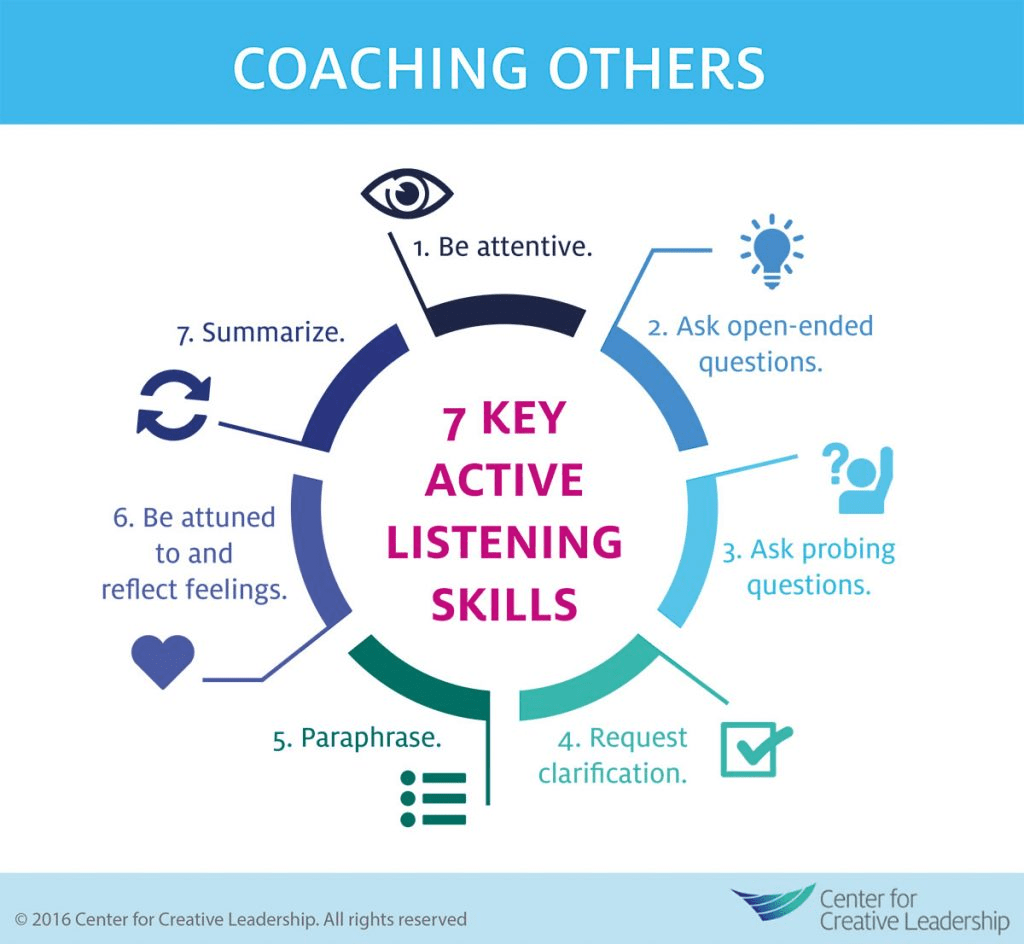
Many of the skills needed for self-coaching are the same as coaching others. Here is a great list from the Center for Creative Leadership. They are just as relevant for self coaching.
Enhancing your toolset can be an added benefit of self-coaching. Many people imagine self-coaching is self reflection, but it also involves inner dialogue; action research; data gathering and analysis; active sense making; and constructive challenging.
What tools do you already use in other contexts? What else would you love to try?
In my book Dancing with fear and confidence, the final part is all about self-coaching. There are tried and tested tools you can use for yourself.
Top tips
Finally, here are five top tips…
- Your self-coaching is your self-coaching. A major benefit of self-coaching is the freedom you have to practice your way. If you think visually, use visual techniques to get out of your head and think differently. If you think better out loud, use auditory methods to stimulate and listen to your own voice. If you need to immerse yourself in an experience, find ways to simulate a five senses environment – or make good use of action learning.
- Mindset – then skillset – then toolset. In self-coaching, you need to develop both your mindset as coachee and coach. As coachee, are your ready, willing and able to be coached? Do you trust yourself as coach? As coach, can you be the unbiased, challenging, supporter you need?
- Bring fresh data and fresh thinking into your self-coaching. Help yourself think differently, by searching out new and relevant data. Inquire into yourself – with real time observations rather than habitual thinking.
- Draw on others perspectives. Get creative about how you make the most of other perspectives. For example, you can use an empty chair to represent someone else and have a conversation with them, getting their input.
- Practice, practice, practice. Self-coaching is a practice, you need to dive in and do it to improve. Begin with well-established, trusted methods.
Coaching is often seen as having a conversation with yourself, usually with someone else’s help. So why not, practice having some of those conversations with yourself – coaching available at any time, anywhere, for free! Not the same, but potentially equally valuable.
Further reading
Biswas-Diener, R., & Dean, B. (2007). Positive psychology coaching: Putting the science of happiness to work for your clients. Wiley.
Fukuda, S. T., Sakata, H., & Pope, C. J. (2019). Developing self-coaching skills in university EFL classrooms to encourage out-of-class study time. Innovation in Language Learning and Teaching, 13(2), 118–132.
Koshy, V (2010) Action Research for Improving Educational Practice. A Step-by-step guide. Sage, London.
Theeboom, T., Beersma, B., & van Vianen, A. E. M. (2014). Does coaching work? – A meta-analysis on the effects of coaching on individual level outcomes in an organizational context. The Journal of Positive Psychology: Dedicated to Furthering Research and Promoting Good Practice, 9(1), 1-18.
Tupper, H., and Ellis, S (2022) You Coach You: How to overcome challenges and take control of your career. Penguin Business.
Walker, Laura (2020) Dancing with fear and confidence: How to liberate yourself and your career in midlife. Mpowr Publishing
 Fulfilling work