This weekend, my twin and I turned 55. Not as big a birthday as 50 or 60 probably, but it does seem to put us into a different age group on some forms – over 55!

And yes – in this photo we are on our way to Mamma Mia The Party! Only the second time as adults we have worn the same outfits.
For me, turning twenty nine was a big panic moment. Of course, it wasn’t twenty nine itself that mattered, it was the anticipation of turning thirty.
At that stage I had been married for a while but we didn’t have children yet. Big questions swirled around in my mind – making me dizzy and staying unanswered for weeks. Am I ready to grow up? Do I even want to be married? Will I ever really be ready for children? Can I be a good Mum?
The anticipation of forty and fifty wasn’t great either, if I’m completely honest. The prospect of becoming ‘middle-aged’ wasn’t something I ever aspired to. Who does!
Big birthdays
Big birthdays have a powerful impact—and the anticipation before them can be even stronger. Studies show that birthdays with a nine are more associated with certain life events than the 40, 50 or 60 themselves.
People are more likely to sign up for their first marathon, more likely to seek an extramarital affair, and more likely to attempt suicide if their age ends in a nine.
A looming big birthday signifies a new era, a loss of time, and changing expectations. The psychological impact of a significant milestone is not restricted just to birthdays—it’s an inherent bias about round numbers in general – the round number bias.
Despite time travelling at a constant rate, people attribute more meaning to certain dates—like the new year or a new decade. When setting goals, people generally aim for a round number too—such as 100 rather than 99. Products with a price ending in 99 are considered more attractive.
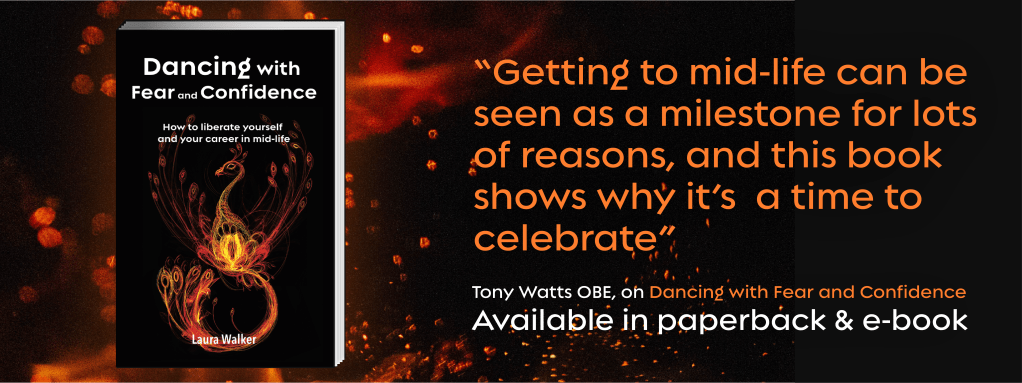
EXTRACT FROM DANCING WITH FEAR AND CONFIDENCE BY LAURA WALKER
For mid-life birthdays, the effect is further magnified by societal judgements about getting older. Unfortunately, people are indoctrinated with toxic ideas about mid-life and these seep into how people feel about joining the middle-aged crowd.
The mid-life crisis is one of these powerful and damaging myths.
Challenging time, but rarely a crisis
Elliot Jaques has a lot to answer for. He is the psychologist who coined the phrase mid-life crisis in 1965. Later studies have challenged his work which was based only on clinical patients.
Search mid-life online and you are inundated with page after page of crisis symptoms and advice about how to deal with it. The phrase is banded around as a judgement, a label, an explanation. It makes people a cliché and the butt of jokes.
They are just having a mid-life crisis!
It was an affair or a sports car, so I directed him towards the car
Ignore them long enough and they will go back to normal
Most people, however, are not having a crisis in this sense of the word. They are just attempting to navigate a uniquely challenging time. As they become aware of their own mortality, one way or another, it is natural to take stock and make different choices.
In fact, the word crisis originated from the Greek word krisis which means decision or decisive point.
Big birthdays can become important decision points for many, prompting us to pause to take stock of our lives. An entirely natural process, rather than the societal, disparaging version.
Maybe you have a big birthday coming up, or a family member? How can you take the time you need? How can you support rather than ridicule them?
Further reading
Weiss, D., Lang, F. R. (2011) They Are Old But I Feel Younger: Age-Group Dissociation as a Self-protective Strategy in Old Age. Psychology and Aging Vol. 27, No. 1, 153–163
Altera, A. L., Hershfield, H., (2014) People search for meaning when they approach a new decade in chronological age. PNAS Vol. 111, No. 48
Fraser-Mackenzie, P., SungJ, M., Johnson, E.V. The prospect of a perfect ending: Loss aversion and the round-number bias. Organizational Behavior and Human Decision Processes. Volume 131, November 2015, Pages 67-80
Jaques, E. (1965). Death and the mid-life crisis. The International Journal of Psychoanalysis, 46(4), 502-514.
 Fulfilling work