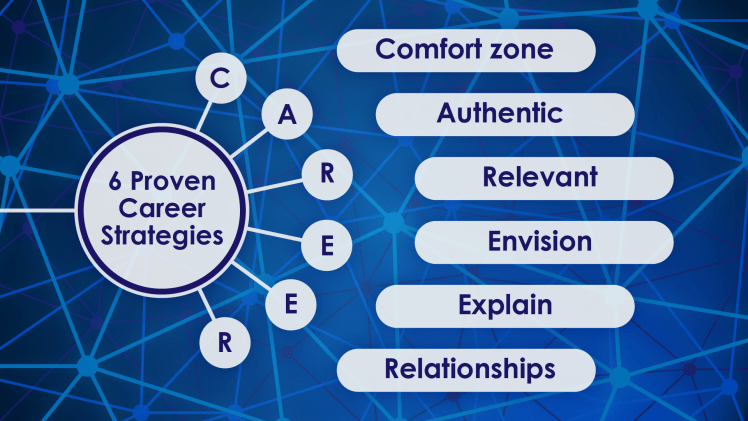
The half life of skills is estimated to be five years according to LSE! With the invention of AI, and in particular GenAI, there is a good chance this will reduce further. It’s not surprising then that our third proven career strategy is to be, and stay, relevant.
Relevance: The degree to which something is related or useful to what is happening or being talked about (Cambridge Dictionary)
The nature of careers – and what this means for a relevant career:
- Careers are a powerful social construct – they are not an object and only exist because we humans understand that they do
- Their impact can be real and strong though. Your career influences your wealth, health and happiness, your social standing and how others relate to you.
- This means they can, and often do, change.
- Traditionally careers would have 3 stages – education, work, retirement. With a longer career there are more stages and more career changes.
- Research shows those entering the workforce now can expect to have 5-7 career changes.
- According to the stats, at least two thirds of people cite chance as a major influence on careers success.
- What is a ‘good career’ is contextual and differs across cultures, geographies, and time.
So – all this means that careers are dynamic, more so than ever, and standing still is really not an option. Everyone and everything around you is shifting and you need to keep up. You need to be adapt-able.
Being career relevant means being career adapt-able
Career adapt-ability is the capacity to use psychosocial resources to adapt to changing contexts for career satisfaction and success.
Career adapt-ability is probably one of the most tested and validated concepts in the world of careers. A team of researchers from 13 countries constructed and validated the work and also developed an associated measure with 4 subscales:
- Concern (planfulness)
- Control (deliberateness)
- Curiosity (inquisitiveness)
- Confidence (assuredness)

| Adapt-Ability Resources | Descriptive Qualities |
| Concern – Oriented toward the future and inclined to anticipate and prepare for career moves | Aware, oriented, anticipating, involved, planful |
| Control – Disposed toward deliberateness and conscientious in building a career | Conscientious, responsible, assertive, reliable, disciplined |
| Curiosity – Given to inquisitiveness about possible selves, opportunities, and information | Open, inquisitive, exploratory, imaginative, innovative |
| Confidence – Assuredness to make realistic career decisions and solve problems in moving toward occupational goals | Resilient, assured, flexible, efficient, persistent, steadfast |
If you’d like to assess your career adapt-abilities this site provides a PDF version of the scale. It’s not an interactive online test, but you can print it out or fill it in electronically.
CAAS master.pdf (vocopher.com)
Market-relevant
Also, at a practical level, how purposeful are you at getting / staying ‘market relevant’? Why not try the following:
- Create a summary of the top industry trends – maybe through initial online searches, then test and develop it with input from your network
- Arrange informational conversations with a variety of people – get curious about their work, what they’re hearing / seeing / anticipating in your market, how they invest in their skills
- Put yourself out there – say yes to a few more invitations
- Review and improve your online brand (e.g., LinkedIn) – how do you measure up in the market, do your profiles show how relevant you are?
Planned happenstance
Finally, I love the notion of ‘planned happenstance’. Originally developed by Stanford Psychologist Professor John Krumboltz, it was the first theory to embrace the role of chance in career development.
Individuals are encouraged to have some ideas, do some generally positive things in broadly the right direction, and have confidence that in doing so, great things can and will happen. It’s about being active and doing the right kinds of things, even if you don’t know exactly where your actions will lead.
It’s about being open to unplanned events, but also making sure you are well positioned to make the most of them.
 Fulfilling work