As humans, we are biased to the status quo. A wealth of studies show that the status quo option is the most preferred in all kinds of decision making – due to loss aversion, regret avoidance, or greater familiarity. The status quo seems safer, less painful, easier.
- I am good at what I do, and I am rewarded well. I should stay where I am.
- What if I make the wrong decision? The grass isn’t always greener, you know.
- Better the devil you know.
But they forget that everything around them is moving – skills are changing, technology is developing, people are joining and leaving the workforce, processes and systems are improving. Standing still, inside your comfort zone isn’t really an option anyway.
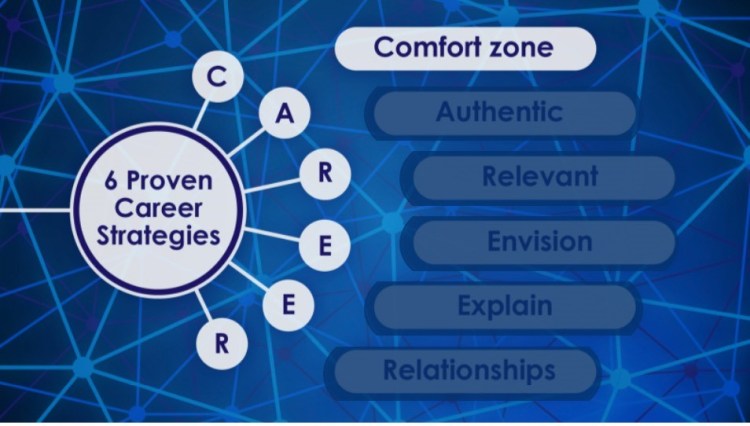
Comfort zone: A situation in which you feel comfortable and in which your stability and determinations are not being tested
Cambridge Dictionary
To stay relevant and in demand, we have to keep growing and learning. A fundamental and proven career strategy is to stretch your comfort zone by boosting your learning agility.
Learning agility is the ability to learn new things and to apply that learning in new and different situations
Echinger and Lombardo, 2004
It’s a better predictor of future potential than IQ, background or previous experience.
You can grow your learning agility by having new experiences and taking the time to make sense of what you have learned – individually or with others. Importantly, there is no age limit to learning agility, so we can keep learning throughout our lives.
Boosting your learning agility begins with stretching your comfort zone. How much you stretch it though is up to you.
Bored in his work, Daniel realised he needed something to change—so he decided to say yes to every opportunity that presented itself over the next few weeks. And he did. Socially and professionally.
extract from Dancing with fear and confidence by laura walker
He said yes to joining a local networking group, to a canoeing weekend, to a public speaking course, to becoming a mentor, to joining a quiz team—none of which he had done before.
He liked some more than others. Some were nerve-wracking. Some he wished he’d done them before. Whatever his reaction, they all taught him something useful.

Here are three self-coaching questions to help get you started…
- What would help me say ‘yes’ to more new experiences? And what else?
- Who do I know that invests in their learning agility? Would they be willing to have a chat about what they do?
- When did I last feel outside my comfort zone, and what did I learn from that experience?
Further reading
Eichinger, R.W., Lombardo, M.M. (2004). Learning Agility as a Prime Indicator of Potential. Human Resource Planning; New York Vol. 27, Iss. 4 12-15.
Ibarra, H. (2004). Working Identity: Unconventional Strategies for Reinventing Your Career, Boston: Harvard Business School Publishing
Samuelson, W., Zeckhauser, R. Status quo bias in decision making. J Risk Uncertainty 1, 7–59 (1988).
Walker, L (2020). Dancing with fear and confidence: How to liberate yourself and your career in mid-life. MPowr Publishing.
 Fulfilling work